
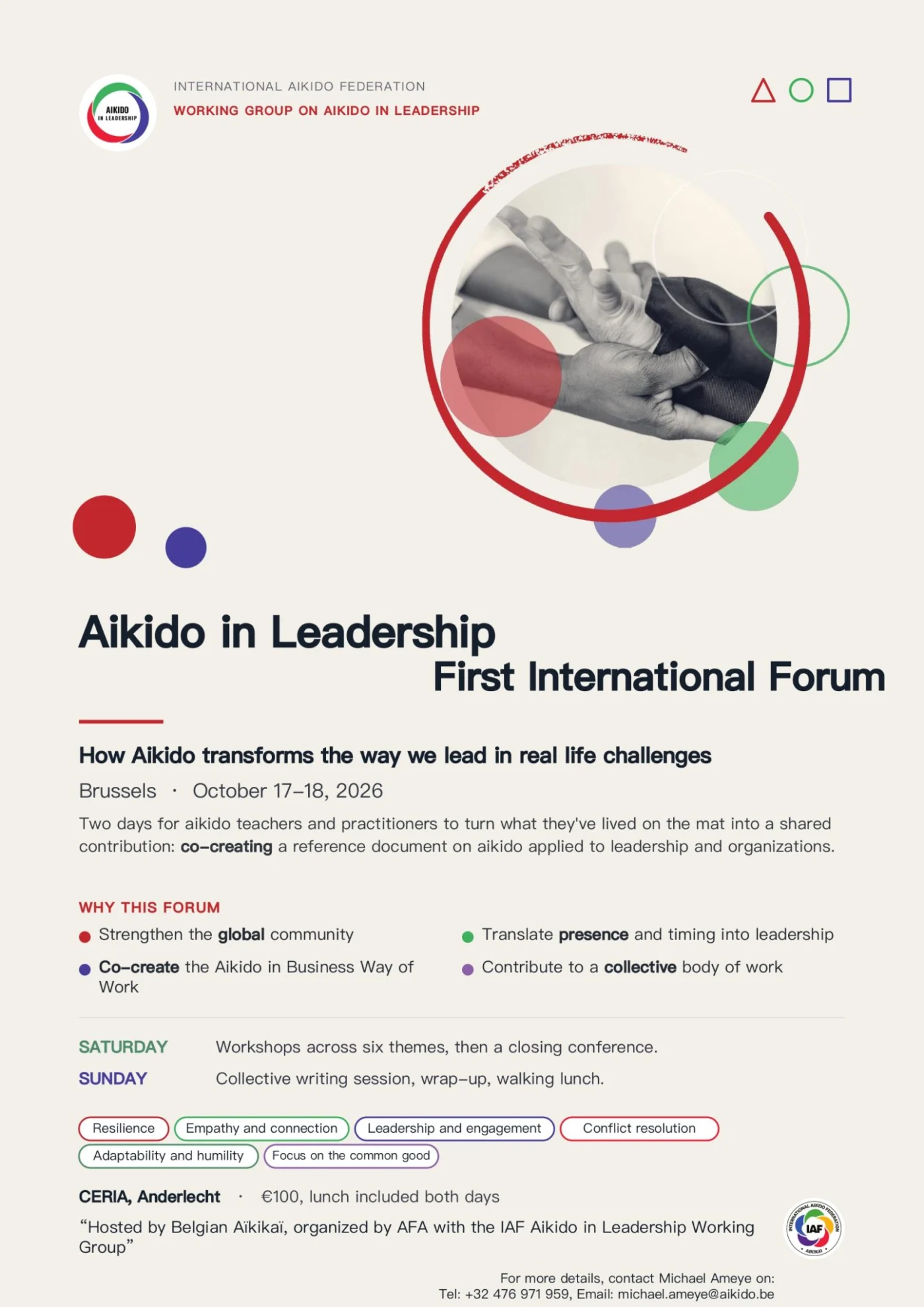
On 17 and 18 October 2026, Brussels will host the first edition of the international forum Aikido in Leadership, organised by the International Aikido Federation (IAF).
The event will bring together Aikido teachers and practitioners around a shared question: how can the principles developed on the tatami also apply to the challenges of leadership, cooperation and handling complex situations?
Over two days, the discussions will revolve around six main themes: resilience, empathy and connection, leadership and engagement, conflict resolution, adaptability and humility, and the pursuit of the common good.
The forum also has a very concrete goal: together, the participants will contribute to a reference document on applying the principles of Aikido to leadership and organisations.
On 9 October, the LinkedIn group Aikido in Leadership published an article by Dr Ahmad Salih: "When the Room Has a Dominant Force: Aikido, Psychological Safety, and the Art of Centered Presence".
He starts from a scene every aikidoka knows. One practitioner steps onto the mat and the atmosphere changes. Newer students hold back, drift toward safer partners, train carefully so as not to be noticed. He argues that this is not a technique problem but a psychological safety problem, and that the same withdrawal happens in boardrooms, committees and professional forums.
A few of his ideas:
- Tension is not the enemy; unprocessed tension is. Matching a dominant force creates conflict; collapsing away from it hands the room over to it.
- Irimi-tenkan as the third option: enter close enough to feel the force, then turn. A turn without the entry, he writes, is "retreat with good posture".
- Centering is an active practice, renewed again and again under pressure, not a calm state you decide to be in.
- Ma-ai in a meeting: knowing when to speak and when to stay still, when closeness creates connection and when it creates collision.
- Psychological safety does not come from removing difficult personalities, but from having people grounded enough to hold the space, and to widen the circle so that more voices can be heard.
He illustrates this with four years spent working under a dominating manager, and with how bringing the mat into that relationship changed the quality of their exchanges.
The article also connects these ideas to the themes of the Brussels forum, 17–18 October.
Read the full article: https://www.linkedin.com/pulse/when-room-has-dominant-force-aikido-psychological-usb3f/
What do you recognise from your own practice, on the mat or at work? Share your view in the comments.
In April 2005, Aiki Extensions, a sister organisation of ours, organised a seminar called Training Across Borders in Nicosia, Cyprus, in the UN buffer zone that divides the island. Donald Levine led the project, with Richard Strozzi-Heckler among those who developed it.
About a hundred people trained together for several days: Palestinians, Israelis, Bosnians, Serbs, Greeks, Turks, Jordanians, Americans and others. The organisers chose not to put the word "peace" in front. People came to practise Aikido with partners from the other side of a conflict.
It is one of the clearest examples of Aikido used as a meeting place rather than as a subject of discussion.
Do you know of similar projects today?
Paul Linden is chief instructor at Aikido of Columbus, a sixth-degree black belt, and a Feldenkrais instructor with a PhD in physical education. He has served on the board of Aiki Extensions, a sister organisation of ours.
He developed Being In Movement, a body-awareness training built on Aikido principles. His starting point: under threat the body contracts, and a contracted body cannot think or act well. So he teaches people to notice that contraction and to find a state he describes as calm alertness and compassionate power.
He has used this with survivors of abuse and trauma and in peacebuilding work. His e-book "Embodied Peacemaking" presents the exercises.
Which of your own practices start from the body rather than from words?
Donald N. Levine (1931–2015) was a sociologist at the University of Chicago, where he was Dean of the College from 1982 to 1987. He was also a fourth-degree black belt in Aikido.
He brought the two together. At the university he taught a course that combined conflict theory with Aikido practice on the mat. In 1998 he founded Aiki Extensions, a sister organisation of ours: a non-profit that connects people who apply Aikido principles outside the dojo, in business, schools, therapy, mediation and community work.
His question was simple: what happens to what we learn on the mat when we step off it?
Did you ever meet him, or work with people from Aiki Extensions?